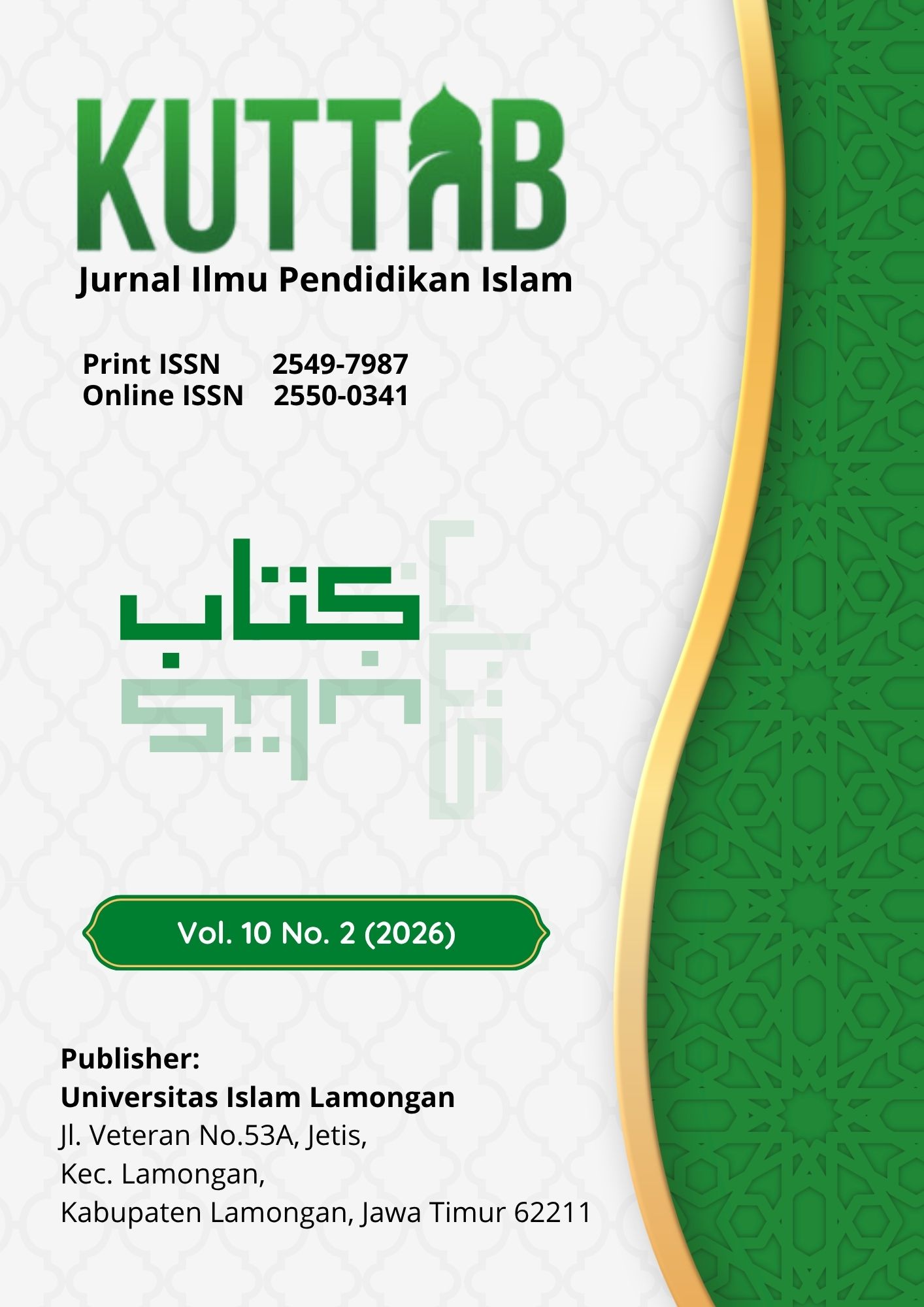
Developing Religious Competence Through the Imamah Examination: A Case Study of Female Students at Gontor for Girls Campus One
DOI:
https://doi.org/10.30736/ktb.v10i2.2911Keywords:
Character Development, Experiential Learning, Imamah Examination, Islamic Boarding School, Religious CompetenceAbstract
Religious competence is a fundamental objective of Islamic education, particularly in Islamic boarding schools, where students are expected to master religious knowledge, worship practices, and character values. This study aims to examine the role of the Imamah Examination in developing religious competence among female students at Gontor for Girls Campus One. The research employed a qualitative case study approach involving fifth-year female students, supervising teachers, and examiners. Data were collected through observations, semi-structured interviews, and documentation, and analyzed using thematic analysis. The findings indicate that the Imamah Examination serves not only as an assessment instrument but also as a learning process that enhances students’ religious competence through direct practice and continuous guidance. The examination contributed to improving students’ mastery of Qur’anic recitation, tajweed application, congregational prayer leadership, and understanding of prayer jurisprudence. In addition, it fostered self-confidence, responsibility, discipline, and leadership skills. Supporting factors included the religious boarding school environment, systematic mentoring, and structured assessment procedures, while limited preparation time and students’ initial lack of confidence emerged as challenges. The study concludes that the Imamah Examination is an effective practice-based educational model for developing religious competence and character among female students in Islamic boarding schools.
Downloads
References
Alamin, N. S., Rahmawati, Z. S., Maha, M. B., Nisa, S., & Zalzuli, A. (2024). HIDDEN CURRICULUM IN STUDENTS ’ ACTIVITIES AT MODERN ISLAMIC BOARDING SCHOOL : Phenomenology Study at Darussalam Gontor Islamic Boarding School , Ponorogo , East Java. 48(1), 57–72. https://doi.org/10.19109/elidare.v9i2.18884.2
Ashari, R., Sukrisna, C., Budiman, A., Zarkasyi, A., Barid, M., & Wajdi, N. (2022). THE INTEGRATIVE CURRICULUM MANAGEMENT WITH A BOARDING SYSTEM IN HIGH SCHOOLS. 14(1), 483–496. https://doi.org/10.37680/qalamuna.v14i1.4398
Azzuhri, M., Huang, M., & Irawanto, D. W. (2024). Reinventing spiritual leadership from an Indonesian perspective. International Journal of Cross Cultural Management, 2(24), 289–308. https://doi.org/10.1177/14705958241245245
Cahyo, H., Kistoro, A., Ru, S., Husna, D., & Burhan, N. M. (2022). Dynamics of the Implementation of Experience - Based Religious Learning in Indonesian and Malaysian Senior High Schools. 19(2). https://doi.org/10.14421/jpai.2022.192-07
Desfita, V., Lubis, S. A., & Rusman, A. A. (2023). Religiosity As The Main Pillar of Character Education In Islamic Boarding School : A Study In Langkat District. November, 655–668. https://doi.org/10.30868/ei.v12i04.8329
Husaini, Q. M., & Hasanah, A. (2024). Qudsi Mutawakil Husaini, Aan Hasanah, dan Bambang Samsul Arifin Character Education Methods At Islamic … 18. 6(2), 18–38. https://doi.org/10.54437/ilmuna
Jubaedah, Yani, A., Komalasari, S., & Aminah, S. (2024). TOFEDU : The Future of Education Journal. 3(5), 2168–2177. https://doi.org/10.61445/tofedu.v3i5.368
Kartiko, A., Rofiq, M. H., Fahmi, Q., & Samson, N. A. T. (2026). Character education from the perspective of Islamic boarding school (pesantren): An implementative study. Fikroh: Jurnal Pemikiran Dan Pendidikan Islam, 1(19), 70–84. https://doi.org/10.37812/fikroh.v19i1.1790
Mccarron, G. P., Yamanaka, A. O. I., Schierbeek, E., & Fojtik, G. (2022). S O C I A L LY J U S T A N D C U LT U R A L LY R E L E VA N T EXPERIENTIAL LEADER- SHIP LEARNING : CENTERING EQUITY AND INCLUSION IN LEARNERS ’ PRAXIS. 16(3), 38–44. https://doi.org/10.1002/jls.21822
Miftahuddin, Dwi, R., & Yuliantri, A. (2024). Islamic charecter education model: An in-depth analysis for islamic biarding school. 43(2), 370–380. https://doi.org/10.21831/cp.v43i2.66516.
Mtisi, S. (2022). The Qualitative Case Study Research Strategy as Applied on a Rural Enterprise Development Doctoral Research Project. 21, 1–13. https://doi.org/10.1177/16094069221145849
Ramdhan, T. W., & Ramdhan, T. W. (n.d.). KURIKULUM MERDEKA ’ S AUTHENTIC ASSESSMENT FOR MULTICULTURAL ISLAMIC RELIGIOUS. 60–76. doi: https://doi.org/10.35891/amb.v8i2.4196
Robinson, O. C., & Robinson, O. C. (2023). Qualitative Research in Psychology Probing in qualitative research interviews : Theory and practice Probing in qualitative research interviews : Theory and ABSTRACT. Qualitative Research in Psychology, 20(3), 382–397. https://doi.org/10.1080/14780887.2023.2238625
Rochmat, C. S., Silfana, A., Yoranita, P., & Putri, H. A. (2022). Islamic Boarding School Educational Values in Efforts to Realize Student Life Skills at University of Darussalam Gontor. 1(2), 6–15. https://doi.org/10.58418/ijeqqr.v1i2.18
Ruksin, A., Salim, M. A., & Zaironi, M. (2026). Competency-Based Curriculum Development in Islamic Religious Education: Integrating Spiritual Values and 21st-Century Competencies. Journal of Practice Learning and Educational Development, 2(6). https://doi.org/https://doi.org/10.58737/jpled.v6i2.1124
Sasputra, H., & Syarif, M. (2026). Authentic Assessment in Islamic Education : Challenges and Practice. 5, 83–91. https://doi.org/10.58485/jie.v5i1.588
Shreya, M., & Dey, A. (2022). Understanding and Identifying ‘ Themes ’ in Qualitative Case Study Research. https://doi.org/10.1177/22779779221134659
Syarifah, Isroani, F., Hasanah, M. N., & In, M. (2023). The Pattern of Development the New Female Students at The Modern Islamic Boarding School Darussalam Gontor. 6(1), 125–140. https://doi.org/10.32923/kjmp.v3i2.1382
Wahyudi, M., Fachturrahman Spama Putra, M., Rifki, M., & Slamet Riyadi, M. (2024). The Islamic Character Education at Darussalam Gontor Boarding School and Its Implications for Students’ Discipline. 2(2), 36–47. https://doi.org/10.71155/integratia.v2i2.116.
Downloads
Published
Issue
Section
License
Copyright (c) 2026 Amiirotul Majidah, Arly Zahra Maulida, Sabila Pangestuti, Riza Ashari, Syarifah Syarifah

This work is licensed under a Creative Commons Attribution-ShareAlike 4.0 International License.