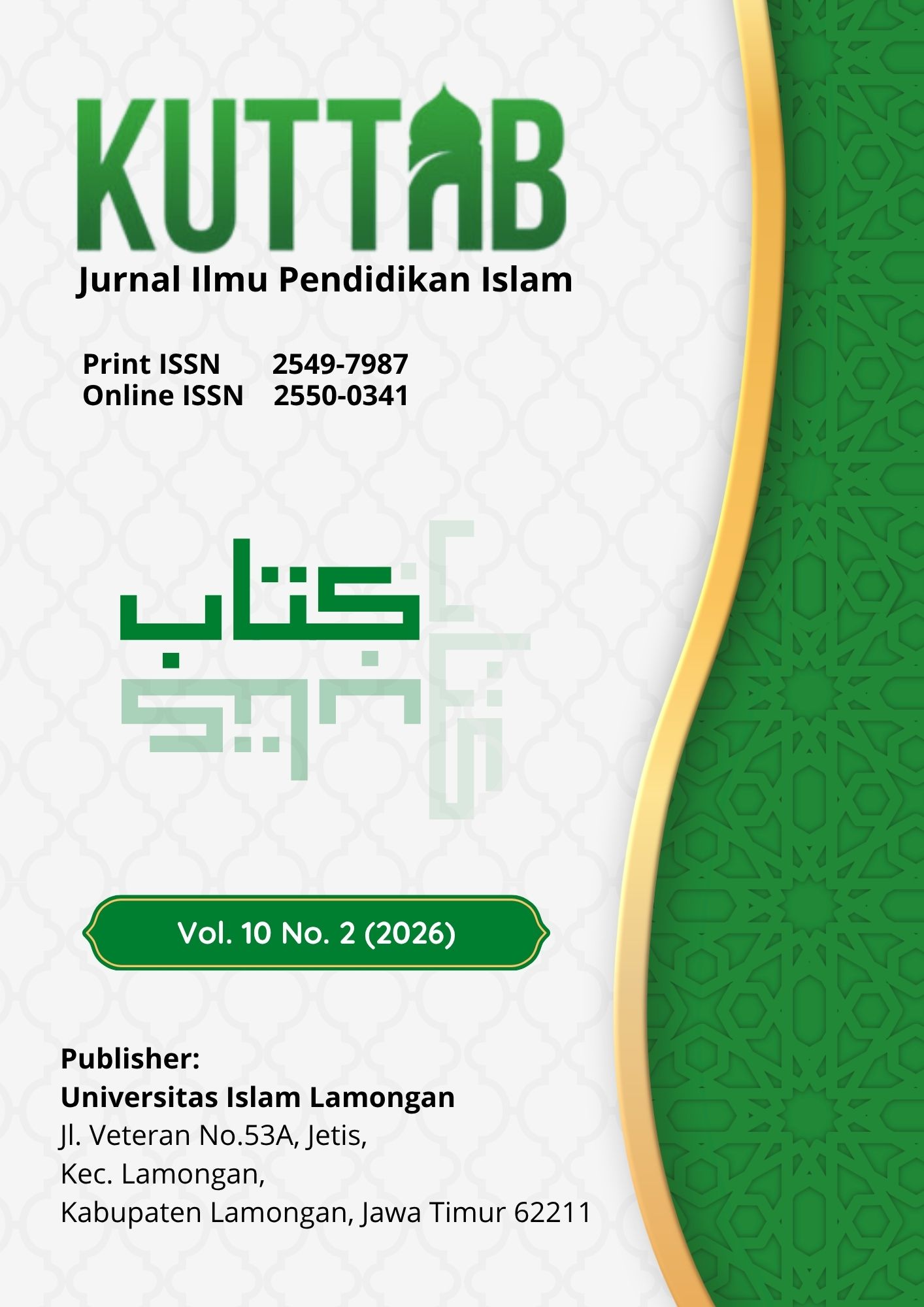
The Concept of Classroom Management Based on the Tarbawi Hadith
DOI:
https://doi.org/10.30736/ktb.v10i2.2871Keywords:
Classroom Management, Educational Concept, Tarbawi HadithAbstract
This study is motivated by the tendency of Islamic Religious Education classroom management research to focus mainly on technical-operational strategies, while the Prophet’s hadiths as a source of pedagogical values have not been systematically formulated into a coherent classroom management model. This study aims to identify hadiths relevant to classroom management, formulate their conceptual dimensions, and relate them to contemporary classroom management theory. It employs a qualitative library research approach. Data were collected through documentation of hadith collections, hadith commentaries, rijāl al-ḥadīth literature, jarḥ wa al-ta‘dīl works, and academic literature on Islamic education and classroom management. The data were analyzed using content analysis and hadith analysis, including hadith commentaries, and assessment of hadith quantity and validity. The findings reveal that the Prophet’s hadiths construct a prophetic-integrative classroom management concept comprising spiritual-transcendental, humanistic-affective, pedagogical justice, communicative-instructional, educative discipline, and socio-collaborative dimensions. This concept emphasizes that classrooms should not merely be managed to maintain order, but also to create a religious, humane, fair, communicative, participatory, and meaningful learning environment.
Downloads
References
Abidin, A. R., Latuapo, R., & Abidin, M. (2023). Strategi guru PAI dalam pengelolaan kelas untuk meningkatkan kualitas pembelajaran PAI. Al-Iltizam: Jurnal Pendidikan Agama Islam, 8(2), 187–197. https://doi.org/10.33477/alt.v8i2.6480
Abu Dawud. (2009). Sunan Abi Dawud (S. al-Arna’uth & M. K. Qarah Balli, Eds.). Dar al-Risalah al-‘Alamiyyah.
Al-Asqalani, I. H. (1379 H). Fath al-Bari bi syarhi Shahih al-Bukhari. Dar al-Ma‘rifah.
Al-Bukhari. (2001). Shahih al-Bukhari (M. Z. bin N. al-Nashir, Ed.; Cet. 1). Dar Thauq al-Najah.
Al-Tirmidhi. (1996). Sunan al-Tirmidhi (B. ‘A. Ma‘ruf, Ed.). Dar al-Gharb al-Islami.
Aminah, N., Maryati., Bachtiar, M., & Ashpandi. (2025). Hadis tentang konsep manajemen pengorganisasian pendidikan dalam perspektif hadits. Indonesian Journal of Islamic Studies (IJIS), 1(1), 98–106. https://doi.org/10.62567/ijis.v1i1.633
Cardenal, M.-E., Díaz-Santana, O.-D., & González-Betancor, S.-M. (2023). Teacher-student relationship and teaching styles in primary education: A model of analysis. Journal of Professional Capital and Community, 8(3), 165–183. https://doi.org/10.1108/JPCC-09-2022-0053
Chow, J. C., Sayers, R., Fu, Y., Granger, K. L., McCullough, S., Kingsbery, C., & Morse, A. (2024). A systematic meta-review of measures of classroom management in school settings. Assessment for Effective Intervention, 49(2). https://doi.org/10.1177/15345084231208671
Duan, S., Bissaker, K., & Xu, Z. (2024). Correlates of teachers’ classroom management self-efficacy: A systematic review and meta-analysis. Educational Psychology Review, 36, Article 43. https://doi.org/10.1007/s10648-024-09881-2
Endedijk, H. M., Breeman, L. D., van Lissa, C. J., Hendrickx, M. M. H. G., den Boer, L., & Mainhard, T. (2022). The teacher’s invisible hand: A meta-analysis of the relevance of teacher–student relationship quality for peer relationships and the contribution of student behavior. Review of Educational Research, 92(3), 370–412. https://doi.org/10.3102/00346543211051428
Fears, S. P. (2023). Connectedness in the classroom: Classroom management in the middle school. South Carolina Association of Middle Level Education, 2(1), 128–132. https://scholarcommons.sc.edu/scamle/vol2/iss1/7/
Hanipah, S., Hermawan, I., & Farida, N. A. (2024). Implementasi keterampilan mengajar mengelola kelas oleh guru PAI di SMA Negeri 6 Karawang. Innovative: Journal of Social Science Research, 4(4), 7547–7560. https://doi.org/10.31004/innovative.v4i4.14022
Ibn Hanbal, A. bin M. (2001). Musnad al-Imam Ahmad ibn Hanbal (S. al-Arna’uth, A. Murshid, dkk., Eds.; Cet. 1). Mu’assasat al-Risalah.
Ibn Majah. (2009). Sunan Ibn Majah (S. al-Arna’uth, Ed.). Dar al-Risalah al-‘Alamiyyah.
Karasova, J., & Nehyba, J. (2023). Student-centered teacher responses to student behavior in the classroom: A systematic review. Frontiers in Education, 8, Article 1156530. https://doi.org/10.3389/feduc.2023.1156530
Li, W., Heward, C., Merrick, A., Astridge, B., & Leow, T. (2024). Prevalence of experiencing public humiliation and its effects on victims’ mental health: A systematic review and meta-analysis. Journal of Pacific Rim Psychology, 18, 1–17. https://doi.org/10.1177/18344909241252325
McLeod, E., & Gupta, S. (2023). The role of psychological safety in enhancing medical students’ engagement in online synchronous learning. Medical Science Educator, 423–430. https://doi.org/10.1007/s40670-023-01753-8
Millah, K., Alfarizi, N., Nur Izzati, A., Putri, C. J., Marhamah. (2024). Meningkatkan hasil belajar Al-Quran Hadist melalui pengelolaan kelas. Jurnal Kajian Ilmu Pendidikan (JKIP), 5(2), 224–228. https://doi.org/10.55583/jkip.v5i2.992
Muslim. (2006). Sahih Muslim. Dār Ṭayyibah li al-Nasyr wa al-Tauzī‘.
Nur Hafid, A., & Hania, N. (2024). Hadis dan kurikulum pendidikan: Menganalisis relevansi ajaran Rasulullah dalam pengembangan materi pembelajaran. Ambarsa: Jurnal Pendidikan Islam, 4(1), 68–85. https://doi.org/10.59106/abs.v4i2.191
Rahmaniar, Y., Warsah, I., Purnama Sari, D., (2023). Effective classroom management strategies to improve student discipline and engagement in Islamic education lessons at SDN 32 Rejang Lebong. Indonesian Journal for Islamic Studies, 1(2), 48–53. https://doi.org/10.58723/ijfis.v1i2.133
Ruhama. (2024). Analisis nilai profetik pada hadis-hadis tentang senyum sebagai komunikasi interpersonal nonverbal. Ash-Shudur: Jurnal Bimbingan Konseling Islam, 1(1).
Shoimah, S., & Khuriyah, K. (2024). Strategi pengelolaan kelas dalam pembelajaran Pendidikan Agama Islam di Madrasah Ibtidaiyah Muhammadiyah Congol. Khazanah Akademia, 8(01), 14–25. https://doi.org/10.52434/jurnalkhazanahakademia.v8i01.296
Tondok, M. S., Suryanto, & Ardi, R. (2024). Building bridges in diverse societies: A meta-analysis of field experimental cooperative learning studies on intergroup relations in educational settings. Societies, 14(11), Article 221. https://doi.org/10.3390/soc14110221
Winarni. (2026). Konsep manajemen pendidikan Islam dalam hadis di era pendidikan kontemporer. Jurnal Ilmiah Profesi Pendidikan, 11(2), 1575–1579. https://doi.org/10.29303/jipp.v11i2.3434
Yusufi, A., & Maula, B. S. (2025). Adab, authority, and motivation in Islamic education: Muslim and Western hadith perspectives on pesantren pedagogy. Jurnal Tawadhu, 9(2), 206–219. https://doi.org/10.52802/twd.v9i2.1844
Downloads
Published
Issue
Section
License
Copyright (c) 2026 Rizqi Hidayati, Hakimuddin Salim, Muhammad Zaki Azani

This work is licensed under a Creative Commons Attribution-ShareAlike 4.0 International License.