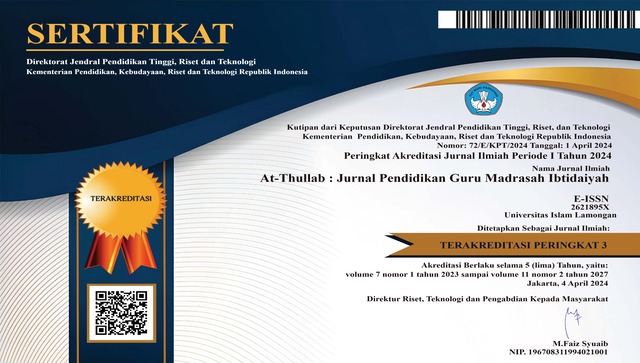
At-Thullab: Jurnal Pendidikan Guru Madrasah Ibtidaiyah aims to be a leading peer-reviewed platform and an authoritative source of information in the field of elementary and Islamic elementary education. The journal publishes original research articles, review articles, and case studies on relevant topics that have not been previously published in any language and are not currently under review for publication elsewhere. The following statement outlines the ethical responsibilities and standards of all parties involved in the publication process, including authors, editors, reviewers, and the publisher.
Duties of Authors
-
Reporting Standards: Authors should provide an accurate account of the original research conducted and present an objective discussion of its significance. Research findings must be reported honestly without fabrication, falsification, or inappropriate manipulation of data. A manuscript should contain sufficient details and references to enable others to replicate the research. Fraudulent or knowingly inaccurate statements constitute unethical behavior and are unacceptable. Authors must ensure that manuscripts comply with the journal’s submission guidelines.
-
Originality and Plagiarism: Authors must ensure that their work is entirely original. Manuscripts should not be submitted simultaneously to more than one publication unless prior agreement for co-publication has been obtained from the editors. Relevant previous works and publications, including those by other researchers and the authors themselves, must be properly acknowledged and cited. Primary sources should be cited whenever possible, and any wording taken directly from other publications must be placed in quotation marks with appropriate citations.
-
Multiple, Redundant, or Concurrent Publications: Authors should not submit the same manuscript to more than one journal simultaneously. Authors are also expected not to publish redundant manuscripts or manuscripts reporting the same research findings in multiple journals. Submitting the same manuscript to more than one journal at the same time constitutes unethical publishing behavior and is unacceptable. Multiple publications resulting from a single research project must be clearly identified, and the primary publication must be appropriately referenced.
-
Acknowledgment of Sources: Authors must acknowledge all sources of data used in the research and cite publications that have significantly influenced the reported work. Proper acknowledgment of the contributions and works of others must always be provided.
-
Authorship of the Paper: Authorship should accurately reflect individuals’ contributions to the research and manuscript preparation. Authors should be limited to those who have made substantial contributions to the conception, design, execution, or interpretation of the reported study. Individuals who have made significant contributions must be listed as co-authors, while those whose contributions are less substantial or purely technical may be acknowledged separately. Authors must ensure that all listed authors have reviewed and approved the final version of the manuscript and agreed to its submission and authorship.
- Disclosure and Conflicts of Interest: Authors must disclose any financial or other substantive conflicts of interest that could influence the results or interpretation of their manuscript. All sources of financial support for the research project must also be disclosed.
- Fundamental Errors in Published Works: If authors discover significant errors or inaccuracies in their submitted or published manuscript, they must promptly notify the journal editor or publisher and cooperate in correcting or retracting the article when necessary.
Duties of Editor
-
Pulication Decisions : Based on the reviewers’ reports and the recommendations of the editorial board, the editor decides whether to accept, reject, or request revisions to a manuscript. Decisions should be based on the validity of the research and its significance to researchers and readers. Editors should follow the journal’s editorial policies and comply with applicable legal requirements concerning libel, copyright infringement, and plagiarism. Editors may consult with other editors or reviewers when making publication decisions. Editors are responsible for everything they publish and must establish appropriate procedures and policies to ensure the quality, accuracy, and integrity of the published record.
-
Review of Manuscripts: Editors must ensure that each submitted manuscript undergoes an initial evaluation for originality and relevance. Editors should manage the peer-review process fairly, transparently, and effectively. The journal’s peer-review procedures should be clearly explained in the author guidelines, including which sections of the journal undergo peer-review. Editors must select appropriate reviewers with relevant expertise and ensure that reviewers have no conflicts of interest.
-
Fair Play: Editors must ensure that all manuscripts are evaluated based on their intellectual content without discrimination based on the authors’ sex, gender, race, religion, nationality, citizenship, or other personal characteristics. Editors must uphold the principles of editorial independence, fairness, and integrity throughout the decision-making process. Since editors hold significant responsibility in determining publication outcomes, all decisions must be objective and unbiased.
-
Confidentiality: Editors must maintain the confidentiality of information related to submitted manuscripts. Editors should carefully address any potential breaches of data protection, research ethics, and confidentiality requirements, including ensuring that appropriate informed consent has been obtained for research involving human participants and for publication when applicable.
-
Disclosure and Conflicts of Interest: Editors must not use unpublished information disclosed in submitted manuscripts for their own research purposes without the author’s written consent. Editors should not participate in editorial decisions regarding manuscripts in which they have conflicts of interest.
Duties of Reviewers
-
Confidentiality: Reviewers must treat all information related to submitted manuscripts as confidential and privileged. Manuscripts must not be shared with or discussed with others unless authorized by the editor.
-
Acknowledgment of Sources: Reviewers should ensure that authors have properly acknowledged all sources of data used in the research and identify relevant published works that have not been cited. Any statement indicating that an observation, derivation, or argument has been previously reported must be supported by appropriate citations. Reviewers should immediately inform the journal if they identify ethical concerns, irregularities, substantial similarities between the manuscript and another submission or published article, or potential research or publication misconduct. However, reviewers must maintain confidentiality and should not personally investigate such concerns unless requested by the journal.
-
Standards of Objectivity: Reviews must be conducted objectively, with reviewers providing clear evaluations supported by appropriate arguments and evidence. Reviewers should follow the journal’s review guidelines and provide constructive feedback to help authors improve their manuscripts. Reviewers should clearly distinguish between additional investigations that are essential to support the claims made in the manuscript and those that may only enhance or extend the study.
-
Disclosure and Conflict of Interest: Information and ideas obtained through peer review must remain confidential and must not be used for personal advantage. Reviewers should not evaluate manuscripts in which they have conflicts of interest arising from competitive, collaborative, or other relationships with the authors, institutions, or organizations associated with the manuscript. In a double-blind review process, reviewers who identify the authors’ identities and recognize a potential conflict of interest should immediately notify the journal.
-
Promptness: Reviewers should complete their reviews within the agreed timeframe. They should only accept review invitations when they are confident that they can provide a timely evaluation. If reviewers are unable to complete the review within the specified period, they should promptly inform the editor so that alternative arrangements can be made.